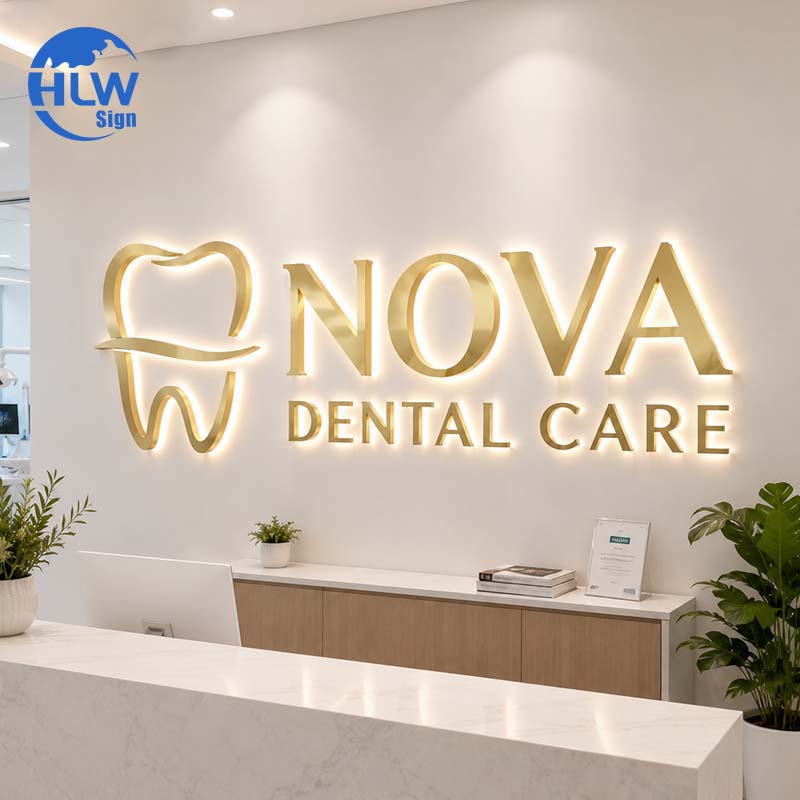
Backlit Sign Cost Per Square Foot: What Drives the Number
Key takeaways
- Area rates suit flat illuminated panels such as light boxes; letters are priced by height, depth and module count.
- The stand-off distance is a cost line, not an afterthought — halo builds need more modules per letter.
- Face material decides the daytime look and a large share of the cost: painted metal, acrylic or brushed stainless.
- Ask for the module spacing and driver brand on any backlit quote; uniformity is where cheap builds show.
Buyers often ask for a backlit sign price per square foot, because that is how printed panels are sold. It is a reasonable instinct and a poor measuring stick: a backlit sign is a light delivery system, and what you are buying is uniformity, colour consistency and weather sealing. This guide explains what actually changes the number.
Related reading: backlit channel letters and halo letters · backlit sign with a baked enamel finish · logo and light box signs · backlit signs and halo letters design guide
When a square-foot rate is the right way to buy
Area pricing works when the product is genuinely flat and uniform: an illuminated panel, a light box face, a printed graphic behind a diffuser. Two panels of the same size, frame and illumination really do cost about the same.
- Light box faces: priced by area, because the frame and lighting stay constant
- Illuminated panels and menu boards: predictable per square metre
- Backlit letters: not area-priced, because the letter shape wastes material and the module layout is custom
- Monument and pylon cabinets: priced by panel count and structure, not by area alone
The five cost lines in a backlit sign
| Line | What changes it |
|---|---|
| Face material | Painted metal, baked enamel, acrylic or brushed stainless — the daytime appearance is bought here |
| Return depth | Deeper returns spread the halo further and need more material |
| Module density | Halo builds use more modules per letter than front-lit, to keep the wall wash even |
| Stand-off and fixing | Spacers, concealed raceway or sub-frame — the halo is invisible if the letters sit too close |
| Sealing and driver | Weather sealing at the cable entry plus a branded driver are the parts that decide service life |

Halo versus front-lit: where the money goes
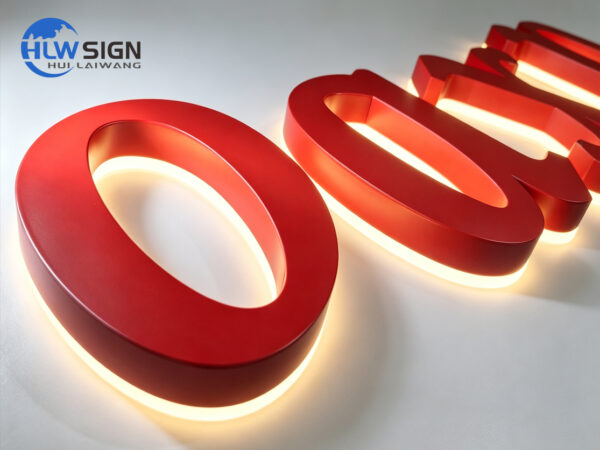
Front-lit letters put light through the face, so the modules can be spaced for even face brightness. Backlit letters throw light at the wall, which means the light has to travel further and stay even across a much larger apparent area. That is why a halo build usually carries more modules and a taller return than the same letter in a front-lit construction.
- Front-lit: fewer modules, opaque-free face, no stand-off needed — the lower-cost illuminated option
- Backlit: more modules, opaque face, stand-off fixings or sub-frame — the premium daytime-and-night look
- Colour consistency matters more on a wall than on a face, so batch-matched modules are worth insisting on
Send a photo of the wall in daylight and tell us whether the sign is seen from 3 m or 30 m. Those two answers change the recommended construction, and quoting before we have them would only produce a number you cannot use.
Budgeting a backlit sign in practice
- Decide the viewing distance, then the letter height that makes it legible
- Choose the daytime finish, because that is where the visible quality is bought
- Confirm the installation surface and the stand-off that suits it
- Ask for the module spacing, LED brand, driver brand and IP rating in writing
- Budget freight and installation hardware as separate lines so nothing arrives missing
Conclusion
Per-square-foot is a fine shorthand for illuminated panels and a misleading one for letters. Price the face material, the return depth, the module density and the fixing — then ask for the LED and driver brands in writing. That is what you are buying, and it is also what you will be comparing two years from now when one sign still looks new.
Frequently asked questions
Is a backlit sign more expensive than a front-lit sign of the same size?
Usually yes, because a halo build needs more LED modules per letter, an opaque face and stand-off fixings or a sub-frame. The difference is modest on large letters and more noticeable on small ones, where the fixing hardware is a bigger share of the cost.
Can you quote a backlit sign from a photo and a size?
Yes. A daylight photo of the installation surface plus the approximate width and letter height is enough to recommend a construction and quote it.
How long do backlit signs last?
Our outdoor builds use IP65 to IP68 rated modules, operate from −20 °C to +50 °C, carry a rated lifespan of 50,000+ hours and come with a 3-year warranty on LED components and 5 years on the structural aluminium housing.
Sources and further reading
- Backlight — Wikipedia — How backlighting works in practice.
- Solid-State Lighting programme — U.S. Department of Energy — LED quality and performance reference.
- IP code — Wikipedia — Weatherproofing ratings explained.
- Channel letter — Wikipedia — Includes the halo / reverse-lit construction.
External links above point to independent reference material. We are not responsible for the content of external sites.