Custom Channel Letters: The Complete Buyer's Guide
Key takeaways
- Channel letters are a metal return plus an acrylic or metal face with LED modules inside — the four main builds differ only in where the light escapes.
- Front-lit is brightest and most legible at distance; backlit (halo) is the premium look; front and back lit combines both; RGB adds colour control.
- Minimum stroke width is 2 cm and letters under about 7 cm are not worth building as illuminated channel letters.
- Weatherproofing, wiring and the LED brand matter more than the face colour when a sign has to survive ten winters.
If you have ever priced signage, you will have noticed that almost every quote is for "channel letters" — yet the numbers vary enormously for signs that look similar in a photo. The reason is that channel letters are a family of constructions, not a single product. This guide explains the four builds we manufacture at HLW SIGN, the numbers that decide the price, and the details worth specifying before you approve a drawing.
Related reading: custom front-lit channel letters for storefronts · backlit (halo) channel letters for hotels and offices · RGB colour-changing channel letters · stainless steel trim front-lit LED letters
What channel letters actually are
A channel letter is a three-dimensional letter built from a metal return (the sides), a face (acrylic or metal) and LED modules mounted inside. The letters are usually mounted on a raceway or individually fixed to the wall, with the wiring hidden behind.
- Returns: stainless steel, galvanised sheet or aluminium alloy, typically 0.5–0.8 mm thick
- Faces: 3–5 mm acrylic, or metal for non-illuminated and halo builds
- Lighting: branded waterproof LED modules (Rishang, Blueview or LEDIT YAKI) with a Mean Well or Huaxin driver
- Finish: brushed or mirror stainless, electroplated, water-plated, or sprayed to any PANTONE or RAL reference
| Build | Where the light goes | Best for |
|---|---|---|
| Front lit | Through the acrylic face | Storefronts, rooftops, distance legibility |
| Backlit / halo | Onto the wall behind the letter | Hotels, offices, premium retail |
| Front & back lit | Face plus halo | Flagship stores, entertainment venues |
| RGB | Colour-changing through the face | Bars, events, brands that change mood |
Front lit, backlit, front and back lit, or RGB?
Front-lit channel letters
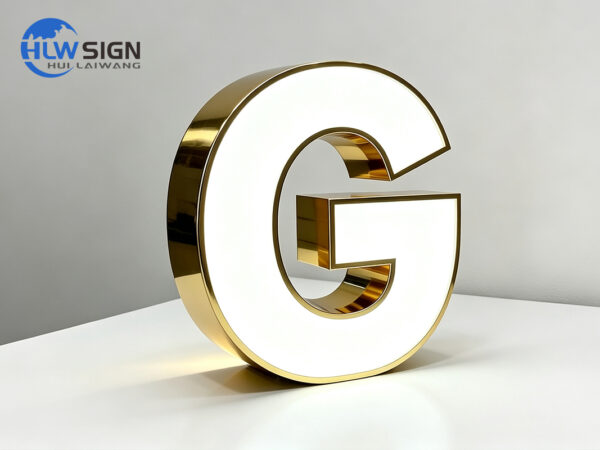
The brightest and most legible option. Light passes through the acrylic face, so the whole letter reads as a solid, even glow. This is the build to choose when the sign has to work from 50 metres away — roadside retail, rooftops, large commercial facades. Faces are cut from 3–5 mm acrylic, and the returns are formed in polished stainless steel with optional electroplating for a gold, champagne or black-steel look.
Backlit (halo) letters
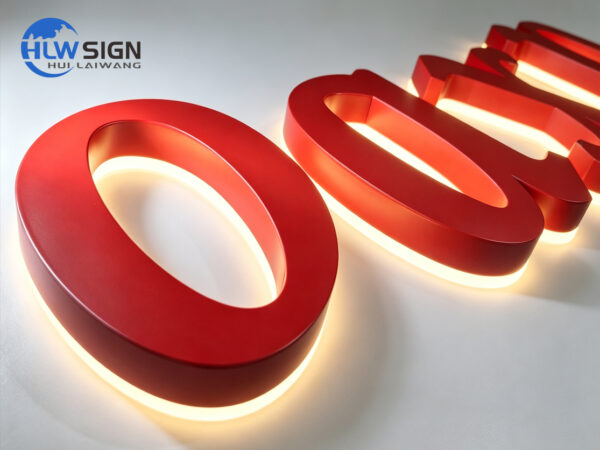
Here the face stays opaque and the LED modules throw light onto the wall behind, creating a soft outline. Nothing about the sign is harsh: it is the construction behind most hotel entrances and design-led shopfronts. It is also more forgiving on imperfect walls, because the halo hides small surface irregularities.
Front and back lit channel letters
The two effects in one letter: an illuminated face for distance readability plus a halo for depth up close. It costs more in both materials and wiring, which is why it is normally reserved for flagship sites, restaurants and venue entrances where the sign is seen at many distances.
RGB and RGBW letters
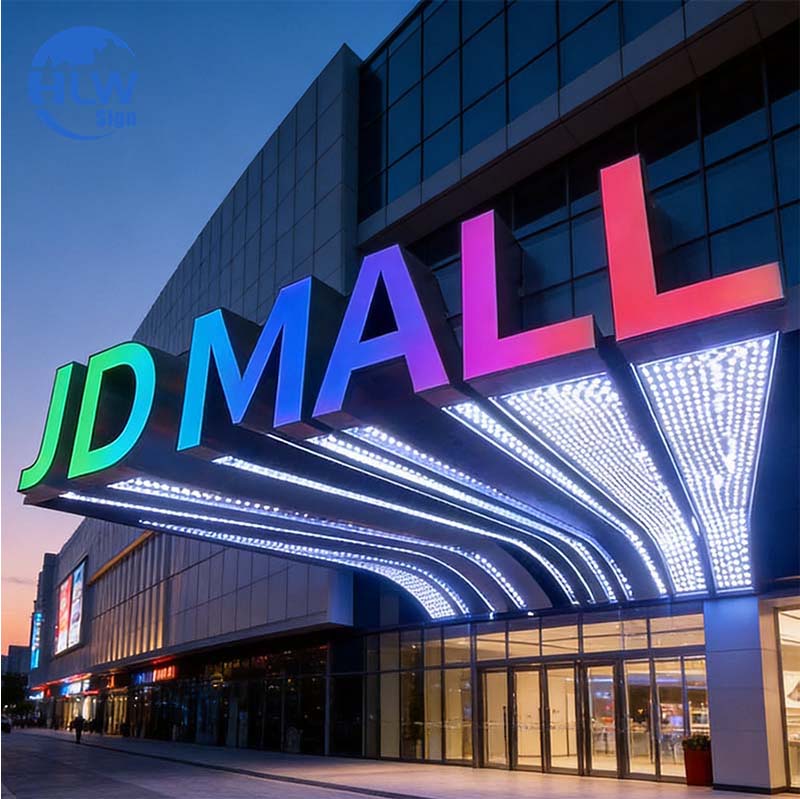
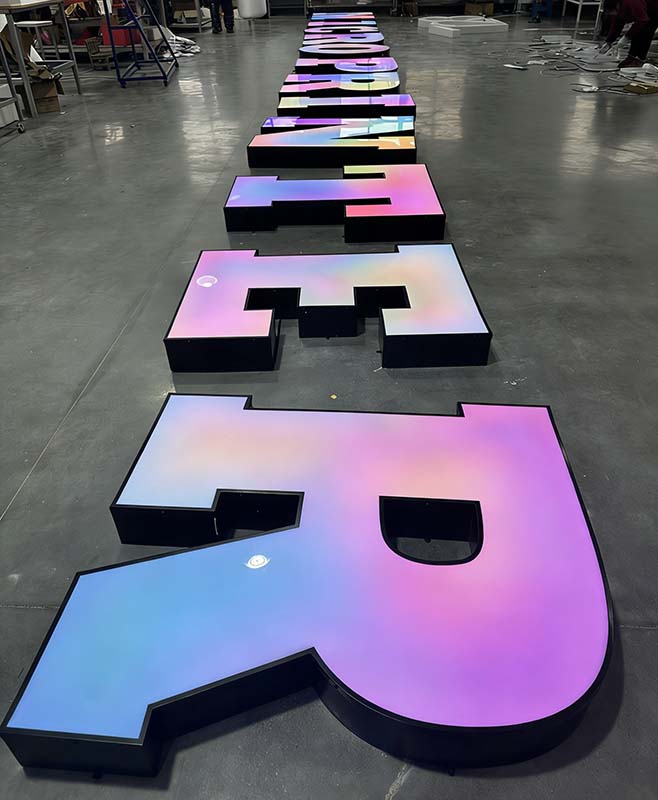
Colour-changing letter signs use RGB or RGBW modules with a DMX512, TTL or SPI controller. Because the modules sit behind a thicker face, these builds normally use 12–20 mm acrylic, and the sign can switch between fixed colours, chasing effects, gradients and static modes. Control is by remote, app, or a scheduled controller — useful when a shop wants one look during the day and another at night.
The numbers that decide the price
Signage quoting is not mysterious once you know which dimensions drive material and labour. For illuminated channel letters, four numbers do most of the work.
- Letter height — the single biggest driver, because the return depth, LED density and face area all scale with it
- Stroke width — the thickness of the letter's legs. Below 2 cm the letter cannot hold enough LEDs for an even glow
- Face area — roughly proportional to the amount of acrylic and the number of LED modules
- Mounting — individual wall fixing, a raceway, or freestanding letters each change the fabrication and the crate size
As a rule of thumb, normal English letters need to be over 7 cm tall to be built as channel letters, and decorative or script fonts need around 20 cm because the thin strokes and tight curves limit how the LED modules can be placed. The side frame height should match the font height: about 5 cm for 20–40 cm letters, 6 cm for 40–60 cm, 6–8 cm for 60–70 cm and 8–10 cm above 70 cm.
Send us the letter height, total sign width, the installation surface and a photo of the site. That is enough for a factory-direct quotation without a site visit in most cases.
Weatherproofing, wiring and the parts that fail first
In our experience the acrylic face is rarely what fails. Failures come from water ingress at the wiring entry point, cheap drivers, and modules that were never rated for the environment. The specification below is what we build as standard for outdoor work.
- IP65 to IP68 rated LED modules, chosen to suit the exposure of the installation
- DC12V or DC24V low-voltage system with overcurrent and short-circuit protection
- Operating range −20 °C to +50 °C for the standard build
- 50,000+ hours LED lifespan under normal operating conditions
- CE, RoHS, EMC and UL listed components available
- A continuous 24-hour lighting test on every sign before it is packed
We also photograph and video each finished sign for approval before shipment, so you see the actual letter glow rather than a 3D render. That single step prevents most disputes on international orders.
How an order runs, from drawing to installation
- Send your logo, artwork or a photo of the site, with approximate letter height and total width
- We advise on construction, materials and lighting, then confirm the final design drawings and specifications with you
- You receive a factory-direct quotation — MOQ is one piece, so a single shop sign is as welcome as a multi-site rollout
- Production takes 7–15 working days after approval, with a 24-hour lighting test before packing
- The crate ships with installation drawings, wiring instructions, mounting templates and accessories; we supply installation videos and technical support after delivery
Expedited production is possible on urgent projects, and we will always tell you honestly whether the deadline is realistic rather than accepting a date we cannot hold.
Conclusion
Choose front-lit channel letters when legibility at distance matters most, backlit when the sign should feel considered rather than loud, front and back lit when the budget allows the best of both, and RGB when the sign has to change with the brand's mood. Whichever you pick, the weatherproofing, the LED brand and the quality of the wiring will decide how the sign looks in year five — so it is worth asking about those before comparing prices.
Frequently asked questions
How much do custom channel letters cost?
Channel letters are quoted by letter height, total illuminated area, construction type and mounting rather than by letter count, because the metal return, acrylic face and LED modules all scale with size. Send the height, width and installation surface and we will return a factory-direct price — MOQ is one piece.
What is the smallest letter size you would build as an illuminated channel letter?
Around 7 cm for normal English letters, with a 2 cm minimum stroke width. Script and thin serif fonts need roughly 20 cm of height to stay clean, and below that we would normally suggest an embossed metal panel or a printed sign.
What warranty do you offer on channel letters?
We provide a 3-year warranty on all LED components and a 5-year warranty on the structural aluminium housing, covering manufacturing defects and LED module failures under normal operating conditions.
How long does production take?
Standard production is 7–15 working days after design confirmation and order approval. The exact lead time depends on the sign type, size, materials and quantity, and expedited production is available for urgent projects.
What is the minimum order quantity?
One piece. We build single shop signs as readily as complete signage packages for commercial projects.
Sources and further reading
- Channel letter — Wikipedia — How three-dimensional illuminated letters are constructed.
- Solid-State Lighting programme — U.S. Department of Energy — Reference material on LED performance and quality.
- International Sign Association (ISA) — Industry body for signage standards and best practice.
- IP code — Wikipedia — What the IP65–IP68 ratings on outdoor signage actually mean.
External links above point to independent reference material. We are not responsible for the content of external sites.